Showing posts with label polling. Show all posts

Thursday, January 8, 2015

New Year, New Congress? Not so much.

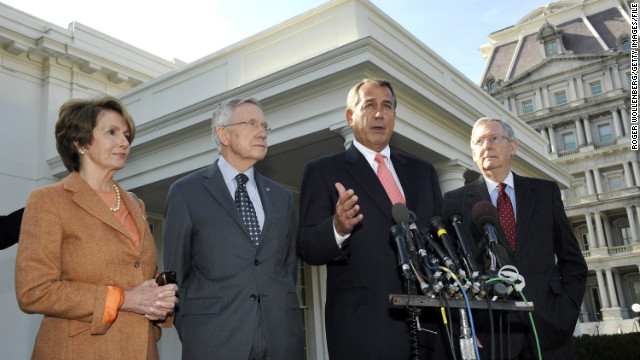
Image from CNN's Political Ticker
This week, with all the expected pomp and tradition, the newly-elected 114th Congress convened for the first time. Not only were 13 new Senators and 58 new Representatives sworn in, but both houses of Congress are also in Republican control for the first time since 2006. With a fresh crop of legislators, the Republican Party has the potential to really change things up, set the political agenda for the next two years—and make a case for a Republican president in 2016.

Things started to get interesting prior to January 6th, and the upcoming vote for House leadership, when a small, but significant group of representatives announced they would not be voting for John Boehner for Speaker of the House. Boehner has held the position of Speaker since 2011, and successfully held off a dozen party defectors in 2013. The list of Republicans joining the “dump Boehner” wagon grew to 25, with representatives taking to Facebook to announce their petition for a new Speaker. Rep. Jeff Duncan (R-S.C.) wrote on Facebook: “A fresh start often requires change, and I believe that change should start with the election of a new Speaker.” Ultimately, however, the conservative scheme failed, with a majority of House Republicans confirming Boehner.

And here we get to the crux of the matter—can a Congress really be “new” if all the leaders are the same? Sure, we have 71 new legislators, but they are all beginners—inexperienced and unlikely to have a lot of influence. Congress’ organization is all about hierarchy. Representatives with the most experience—and time in office—get spots on the most powerful committees and the committee leadership positions. First-time congressmen and women won’t be given the plumb positions because they don’t have the connections and they haven’t proved themselves capable legislators yet.

A fiery member of Congress will probably get amplified by the media and become a maverick favorite, but at the end of the day, leadership positions really do matter. Congressional leaders have a tremendous amount of influence. In the House, Committee heads determine which bills actually make it past the committee to the Rules Committee for a vote. The Rules Committee is the most powerful committee in the House by far. It controls many aspects of how the House runs—from how long representatives have to discuss a bill on the floor, to how many bills can come up for vote each day—and even which bills get voted on at all. The Speaker essentially controls this committee by supporting favorable representatives to fill its slots. Boehner’s power was in full display when he confirmed that the Rules Committee had agreed to vote out two of its members who acted against Boehner—Rep. Daniel Webster (R-Fla.) and Rep. Richard Nugent (R-Fla.).

Although Boehner’s retributive action hasn’t been finalized, things don’t look good for his enemies in the House. And it doesn’t look like we’re going to have a fresh perspective in either house of Congress. Not only was Boehner reconfirmed, but Senator Mitch McConnell (R-KY), who served as Senate Minority Leader from 2007-2015, was also voted in as Senate Majority Leader. On the Democratic side, Senate Minority Leader Harry Reid (D-NV) and House Minority Leader Nancy Pelosi (D-CA) retained their powerful positions as well.


We should feel more than a little worried about leadership stagnation in Congress. Not only has this Congress passed fewer bills than any other Congress in recent history, but friction between members of Congress and President Obama has also led to Congress’ embarrassing approval ratings. Only 14% of Americans approve of Congress—and in August, for the first time, 51% of Americans revealed that they don’t approve of their own members of Congress. Yikes. The only way to reverse these trends is to welcome change and buck the status quo—starting with congressional leadership. Although Congress missed its opportunity to select new leaders, we can only hope that our representatives will commit to some New Years’ Resolutions: tackling the tough issues like Social Security and immigration, and compromising when it will lead to a better outcome for Americans.

Tuesday, November 18, 2014

Congressional Republicans and the Myth of the "Mandate"

Clinton pin from inequality.org
In 1994, after Republicans gained control in the House of Representatives for the first time in 40 years, then House Majority Leader Newt Gingrich called the night the beginning of the “Republican revolution”. When Democrats gained control of both houses of Congress and the Presidency in 2008, many news outlets, such as Forbes, ran articles claiming the victories were a clear “mandate” from voters.

What is a voter mandate? In an article for The Forum, political scientist Hans Noel discusses both the traditional and more fanciful definitions of a political mandate: “In a narrow sense, winning the election gives you a “mandate.” You are now legally empowered to exercise your authority. But after every election, pundits will declare a more complex “mandate.” They will tell you not simply who won, but what that victory means. The winners won because they promised X and voters wanted Y and were afraid of Z.”

In this sense, elections are declared “voter mandates” by the whims of the media. For example, in 2004, when George Bush won his reelection campaign for the presidency with 50.5% of the popular vote and 286 electoral votes, many media representatives called his victory a clear mandate. A USA Today headline on November 4, 2004, for example, read "Clear Mandate Will Boost Bush's Authority, Reach." When Barack Obama won his reelection in 2012 by higher margins, however, media representatives were reluctant to call his victory a mandate. Obama’s 332 electoral votes and 51.1% of the popular vote were not enough to qualify for a mandate. The NPR website, for example, ran an article on November 7, 2012 with the title “For Obama, Vindication, But Not A Mandate”.

Although Republicans have not used the words “mandate” or “revolution” to describe their victory this year, it was easy to sense the excitement. With control of both the House and the Senate, Republicans can effectively dismantle all of Obama’s legislation, including the Affordable Care Act, while introducing ultra-conservative solutions to national debt and immigration reform. But that would be a mistake—especially if Republicans want to capture the White House in 2016.

Republicans should take a few deep breaths before assuming that their congressional victories mean that the country has taken a sharp right turn in the last few years. Far from it. Despite, handing Republicans the Senate, a majority of voters agree with Democrats on several important issues including raising the minimum wage, softer immigration policy, stricter environmental protections, higher taxes for corporations and the rich, legalizing gay marriage, and improving Obamacare rather than repealing it. Republicans in Congress even have lower approval ratings than Democrats. Exit polls showed that voters were dissatisfied with the Obama administration (59%), but an equal number (60%) were dissatisfied with Republican leadership in Congress.

So what is going on? First of all, voters often vote against the incumbent president’s party during midterm elections. In fact, “There have been only three exceptions in the past 80 years: 1934, 1998 and 2002.” Democrats may have been fighting an up-hill battle against a predictable political pattern. The second explanation is that voters don’t often think beyond their own pocketbook. If the economy is bad, voters are mad.

During Bill Clinton’s 1992 presidential campaign, his strategist James Carville coined a variation of the phrase: “It’s the economy, stupid.” That mantra seems more true today than ever before. Voters are fed up with the economy—and blame Obama and the Democrats for how they have handled it. Pollster Gary Langer wrote for ABC News: “Seven long years after the economy tanked, 70 percent of voters Tuesday said it’s still in bad shape. Seventy-eight percent said they’re worried about its direction in the year ahead. Only three in 10 said their own economic situation has improved in the last two years.” The still-struggling economy was given top priority this election and the voter’s discontent was taken out on the President’s party.


So despite an obvious electoral victory, Republicans need to be careful. Their top priority should be fixing the economy. Not only boosting a sluggish economy, but also making sure that Americans feel the benefits of economic recovery. If only 30% of voters feel their economic situation has improved in the last two years, Republicans need to find a way to get money into their pockets. And this may mean focusing on a popular liberal policy—raising the minimum wage. Will Republicans decide to sacrifice conservative ideology in order to have a shot at the White House in two years? We’re about to find out.

Monday, November 3, 2014

Congressional Approval and Midterm Elections

As an astute reader, you may have noticed there hasn’t been a lot of news about Congress recently. One reason: Congressional recess. Not only did Congress take the traditional five-week summer recess, but after an extremely brief 8-day session at the beginning of October, Congress recessed again. This was unusual because the fall session was already cut short so members of Congress could prepare for the midterm election tomorrow—November 4th

House leadership wanted to allow members of Congress more time to campaign, but some representatives have argued that John Boehner may be recessing early to avoid making any difficult policy votes on issues such as immigration reform or health care—until after election time.

Twitter screenshot originally from The Wire.

Approval for Congress has always been low. In the past five years, approval for Congress has always hovered below 40%. In general, the trend of disapproval seems to be continuing downward as the polling numbers sink lower and lower. The percentage of Americans who approve of Congress is currently sitting at 14%, an embarrassing figure.

Original graph and data at Real Clear Politics.

This disapproval, however, was usually not shown towards the voter’s own congressmen and women. Individual representatives were spared the wrath against Congress because voters judged the institution and its members by different standards. While Congress as a whole was expected to fix the nation’s problems quickly and cleanly, individual representatives were judged by their service to their state or district. So even when the average American disapproved of Congress as a whole, they still believed their own member of Congress deserved reelection.

Not anymore. 

It seems that Americans have finally turned on their own representatives. In a Washington Post/ABC News poll out August 3, the numbers reveal that 51% of Americans disapprove of the way their representatives are handling their job. For the first time, a majority of Americans revealed that they were no longer satisfied with their members of Congress.

Data from Washington Post/ABC News poll.

This poll is important for a few reasons:
  1. This fall is a midterm election year. That means that every Representative and a third of our Senators are up for reelection. There are a lot of vulnerable members of Congress as Republicans attempt to take control of the Senate while maintaining their advantage in the House.
  2. In 2012, data showed that 90% of House members and 91% of Senators seeking reelection were successful. But this year, current members of Congress up for reelection shouldn’t take anything for granted.
  3. This particular poll is of voters, not just Americans. This group is more likely to vote this fall. Thus, they are more likely to influence those midterm elections.

Many Americans skip midterm elections—the average is just 40%. Because there aren’t any high-profile races, like for President, Americans stay home. With fewer television commercials during midterm elections, maybe it is just easier to forget that it’s another election season already. But don’t forget to vote! With fewer voters coming out, your vote will have more of an impact. You have the power to change up the power structure in Congress and choose representatives who will hopefully get things done. Let’s get out the vote!

Saturday, August 30, 2014

Is Congress Productive?

Polling indicates that most Americans don’t think so…A poll published on August 3, 2014 by NBC News/Wall Street Journal/Marist College found that 74%, nearly three-fourths of voters, think that Congress has been somewhat or very unproductive this year. Basically—Americans don’t think Congress does anything. So how do we define productivity as it relates to Congress?

At a fundraiser on August 6th President Obama said, "This has become the least productive Congress in modern history…And that's by objective measures, just basic activity." So how would President Obama determine whether or not Congress was productive? One definition of productivity is “the effectiveness of productive effort, especially in industry, as measured in terms of the rate of output per unit of input”. Essentially, in legislative terms, how many laws has Congress passed? In a divided Congress, where Republicans in the House block legislation from the Democratic Senate and vice versa, it is difficult for the parties to compromise and find a version of a bill both houses can pass. So can we simply look at the sheer number of bills passed per session as an accurate measure?

If we calculate productivity by volume of legislation, then yes, the 113th session of Congress has been particularly unproductive, even by historical standards. Total volume of legislation tends to decrease when Republicans and Democrats both control a house of Congress, but the current divided Congress is particularly gridlocked.

Graph from The Fix by Chris Cillizza

What does the Constitution say?

In Article 8 of the Constitution, the duties of Congress are outlined. These myriad responsibilities include: the power to collect taxes, pay off debts, provide for the common Defence and general Welfare of the United States, borrow money, regulate commerce with foreign nations, establish immigration guidelines, coin money, punish counterfeiters, establish post offices and roads, promote the progress of science and the useful arts, provide patents, punish crimes committed at sea, declare war, raise and support armies, maintain a navy, make rules for the governing of army and naval forces and “To make all Laws which shall be necessary and proper for carrying into Execution the foregoing Powers, and all other Powers vested by this Constitution in the Government of the United States”.

That is a pretty comprehensive list of congressional duties. And making laws is just one of them. To be sure, fulfilling many of these duties requires writing legislation, but is Congress required to make new laws?

How do members of Congress use their time?

In fact, most members of Congress spend their time visiting with constituents and raising money for their next election. A PowerPoint presentation given to new congressmen by the Democratic Congressional Campaign Committee (DCCC) outlines an example daily schedule. First, 4 hours of call time, 1-2 hours of constituent visits, 2 hours of committee meetings, 1 hour of strategic outreach and 1 hour of “recharge time”. This makes for a 10 hour day. New legislation is not necessarily being written during any of this time. Especially for member of the House of Representatives who are up for reelection every two years, the time spent calling may not be an exaggeration. In fact, former Representative Tom Perriello (D-Va.) said that four hours to make fundraising phone calls could be “low-balling the figure so as not to scare the new Members too much.”

Slide from a PowerPoint presentation given by the DCCC to incoming members of Congress.


If members of Congress spend four hours per day raising money for the next election, would voters find that time “productive”? Are fundraising events more productive than establishing immigration guidelines or raising and supporting armies? Doubtful. Although Congress doesn’t necessarily need to pass more laws every year to seem productive, Congress does need to act on issues that matter to voters. The idea of immigration reform, for example, has been tossed around for years, but nothing has been done. But in order for voters to view Congress as productive, decisive action needs to be taken on important issues. Unfortunately, expecting a Democratic Senate and a Republican House to compromise on important issues may just be asking too much.